Given Beryl Labs’ vast experience in this specialist field, we can hardly overemphasise the vital importance of understanding all the necessary expenditures, timelines and construction challenges involved in a successful project. With this in mind, we’d like highlight a few considerations that are fundamental to embarking on a project that’ll answer to your objectives.
- Start with the science – the guiding principle behind the build/renovation is, naturally, your research or teaching goals. In this sense, form definitely follows function, and the adequate conveyance of your exact aims to the design team will lead to less design time, a solid build-cost estimate and fewer costly plan alterations once the construction process is underway.
- Know your equipment requirements and research prices – finding out that you’ve overlooked even relatively small equipment necessities will inflate the project’s end-cost. This could have disastrous consequences.
- Know your furniture needs – your staff make the magic happen, and they need to have the correct service supplies at benches and other work areas. Something that slightly complicates the matter is that you also have to contemplate and predict future functions of the lab. A construction that can be adapted to evolving demands is always desirable.
- The ergonomic efficiency of the lab is paramount, but non-lab areas for your staff are important, too. A pleasant working environment is key to productivity and healthy attitudes. Moreover, this could attract desirable future employees.
- Find out what built environment professional teams offer in terms of expertise and the fees they charge. Being specialists, we have to point out that an expert team with the correct experience and knowledge should be able to pre-empt your needs and provide valuable insight at all stages of the build/renovation.
- Know construction timelines and understand the costs involved in lost productivity – this includes shutdowns, interruptions to workflows in labs that must remain active during a renovation, and the costs of temporary relocation if applicable.
- With the above information firmly in hand, re-evaluate your priorities if you’re coming in over budget. If you’ve opted for a new build but aren’t making ends meet, renovations usually cost less, making it an avenue that may yield a better result.
This all may sound like a headache and an immense amount of hard work, but labs can quite easily have a life-cycle of 15 to 20 years – meaning that achieving the best possible result is absolutely imperative. For further information or some helpful guidance to get you started, get in touch with Beryl Labs [link to contact page] and speak to the experts.
]]>The consequences of overlooking properly considered timelines could be disastrous: important deadlines will be missed and, in the effort to meet unrealistic demands, quality could be compromised upon. To avoid this unnecessary complication, we thought it may prove helpful to briefly chat about timelines that should be expected when undertaking the renovation or building of a new lab.
- Predesign Phase – Getting Organized
The predesign phase forms the foundation of the entire project, and success certainly begins with solid groundwork. It’s here that budgets are set and design briefs are created (specifying, amongst others, everything that the lab should accommodate, including: staff, chemicals, samples and equipment). During this phase, guides and manuals are sourced from suppliers, and the exact objectives for the lab are clearly identified: e.g. better workflow, increased storage, energy efficiency, etc. A specialist like Beryl Labs can guide you through this, but much of the work remains internal. Set aside a minimum of 4 weeks for this crucial part of the process.
- First Design Draft
As the first design draft is a culmination of all the lab needs and budget constraints discussed in the predesign phase, at least 2 weeks are required for an optimal design to be developed.
- Subsequent drafts
No matter how well the first design draft answers to the brief, some refinements and alterations should be anticipated. 1 week per subsequent draft is reasonable, and a total of at least 2 subsequent drafts should be expected (making this phase 2 weeks).
- Quotation
1 week must be assigned for the initial quote, and as quote revisions are almost inevitable, another week must be also be allocated for adjustments – bringing the total to 2 weeks.
- Procurement
This phase may vary in length, and is often underestimated – resulting in frustrations, missed deadlines and severe pressures on incorrectly budgeted resources. The duration is highly dependent on the client’s procurement department’s internal processes, but a good average is the timeframe of 4 to 6 weeks.
- Equipment manufacturing and delivery
Quality equipment forms a large part of expenditure, and one has to ensure that adequate time is allowed for equipment manufacture and delivery to site. A fair estimate here is between 6 to 8 weeks.
- Installation and commissioning
Fitting the lab’s equipment correctly is a process that must be given its due provision of time. This phase does vary, but a practical expectation is between 2 to 4 weeks.
- Post-commissioning maintenance
Keeping your new lab in top notch condition is a must, so we highly recommend that a 6-12 month maintenance contract be put in force immediately after the lab has been commissioned.
Given Beryl Labs’ expert knowledge and truly impressive experience, we are fully enabled to help clients develop realistic timelines that can be relied upon to deliver the final product on time and within budget. Please feel free to contact us with your questions, and start your lab build or renovation off on the right foot.
]]>
- Get your staff on-board and ensure that their safety is of paramount importance
Renovations are disruptive – this fact cannot be avoided, and to help your staff adjust to the various inconveniences it is imperative that they understand how the new lab will better their work experience. In order to do this, clear communication about what to expect from the new lab and what to expect during the renovation must take place. By showing that their safety and (best achievable) levels of comfort are non-negotiable priorities, the chances that they’ll adopt a positive and flexible attitude are greatly enhanced. Protective gear, especially ear and eye protection and dust masks, should be figured into the project’s budget. Whereas an experienced contractor will never block fire and emergency exits, for example, it is best to constantly ask staff for feedback, giving them a hand in their own safety and including them in the process of the renovation.
- Know and articulate your critical processes and output aims during the pre-design stage
The earlier you are aware of the workflows and systems that need to be kept functional during the renovation the better. These data are fundamental to the design process as well as to project management. For example, ventilation shafts or utilities may need to be temporarily installed in a section of the lab that will be made operational for a certain period during the renovation. Moving these shafts/utilities to their final position will require drawings that indicate both phases of the construction process. Having a detailed knowledge of your lab’s work necessities will result in a design and project schedule that minimises unforeseen, and costly, obstacles.
- Keep your final objective in mind
As mentioned, renovations will present your lab with unavoidable disruptions. Unfortunately, as much as one may prepare in terms of new workflow plans, lists of equipment that will be affected, output expectations and costs, stressful moments will likely occur. Staff may experience frustrations when their work is slowed or momentarily stopped, and lab managers may sometimes not fully appreciate the difficulties faced by contractors and their employees. During these moments, it is important to keep the end goal in mind, and engage constructively in the process of problem solving.
The above 3 points are in no sense exhaustive, but they will hopefully impart a few foundational considerations when thinking about renovations that require complex project management. If you have any questions or would like to have a chat with an experienced team, please feel free to contact us.
Happy renovating!
]]>Unfortunately, a vibrant research culture that encourages curiosity is not enough to establish and maintain a great lab. The safety of staff and students should always be a central concern, and in our experience too many labs fall short in this endeavour. Two areas in particular are the source of much personal anxiety – the prevalence of substandard fume hoods and the poor storage of hazardous chemicals.
Fume Hoods
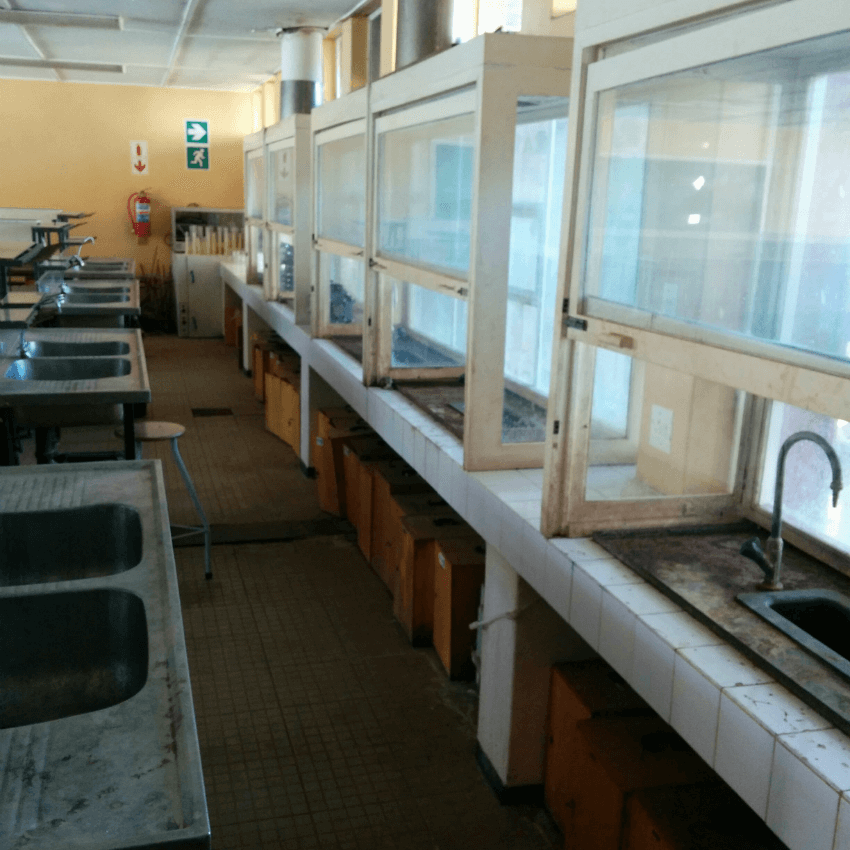
In this first image there is a plethora of worrying features pertaining to the fume hood. To start with, the services control (in this case, the water tap knob) is located inside the fume hood. This means that the user must manipulate the tap from within the chamber, which poses many safety issues: for example, in the event of an explosion, the services will become completely inaccessible.
A second concern is that there is no control panel displaying information regarding current airflow. The control panel is indispensable in keeping the user informed as to whether or not the fume hood is operating within an acceptable airflow range.
Before leaving this deeply problematic fume hood, it must also be pointed out that there is no back baffle. Back baffles play a crucial role in not only reducing the turbulence generated by airflow within the fume hood, but also direct this airflow away from the working surface. Essentially, back baffles act to ensure that the work surface is well ventilated.
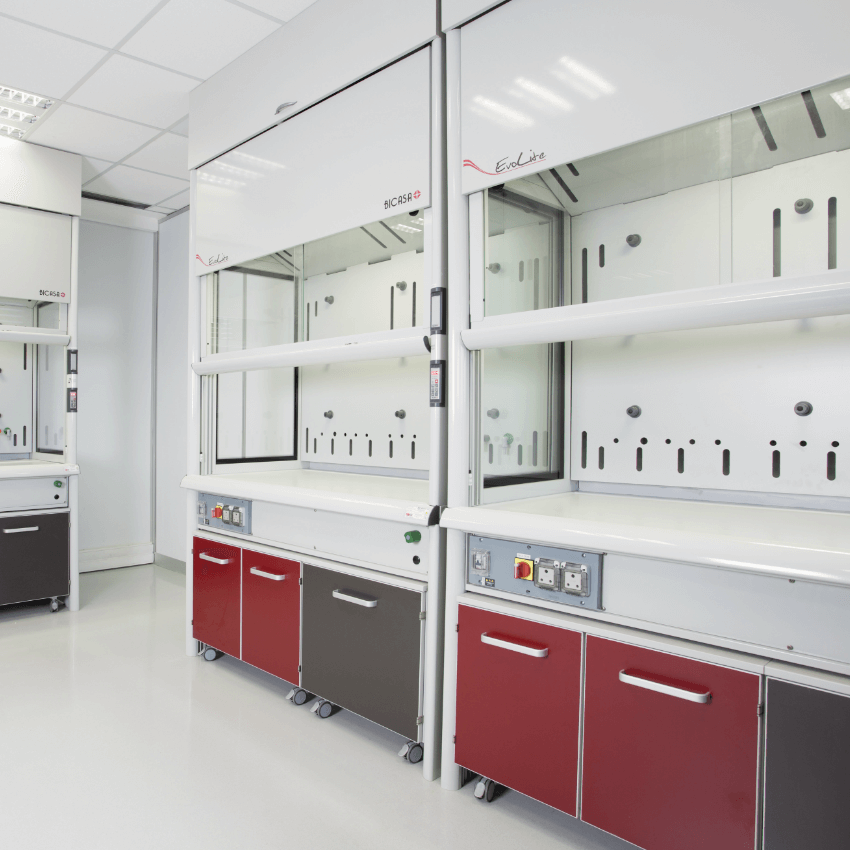
A safe fume hood such as the Evolite Fume hood uses the correct chemical-resistant, non-porous materials and is tested and certified by third-parties. Additional safety features such as an audio/visual alarm add confidence to the safety of your fume hoods.
Chemical Storage


The above two images are the stuff of nightmares, and the proper storage of all chemicals must be an imperative of lab managers, technicians, staff and learners alike. Shelving provided for storing hazardous substances should be built for purpose and fitted to an appropriate standard by a competent person. Additionally, even when structurally sound shelves have been installed it is important to adhere to the following guidelines:
- Never overload shelves – if they are bowed they are overloaded;
- Store breakable containers, particularly those containing liquids and hazardous chemicals below shoulder height;
- Store large heavy containers at low level;
- Maintain good housekeeping on shelves as well as in storage cabinets by keeping clutter to an absolute minimum, and;
- Maintain good stock control and be aware of time-sensitive compounds such as ethers which, once opened and exposed to the air, can produce peroxides which are highly explosive. This means a regular review of what is being stored and the disposal of surplus or unwanted chemicals. Pay particular attention to expiry dates, and remember that the date on which a bottle is first opened should be clearly shown on the label.
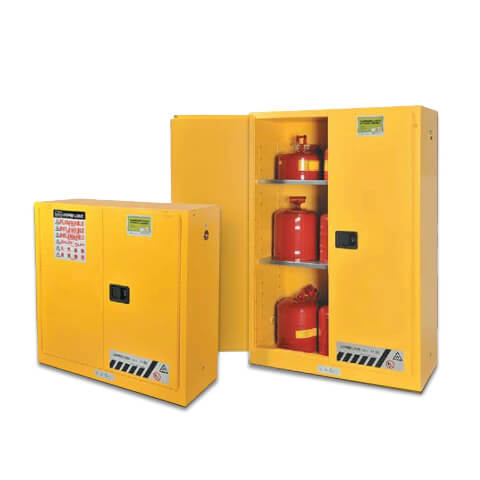
Like fume hoods, make sure your safety cabinets have the correct certifications to store dangerous chemicals. Auditors in South Africa have become increasingly strict about accredited safety storage within South African labs. Make sure your lab is safe and up to code!
It is not a controversial statement to assert that labs that compromise on adequate safety will also compromise on the quality of their work, and if this is indeed true, then the points outlined above can only contribute to a lab that is safe, productive and cost-efficient.
If you have concerns regarding your lab’s safety, please don’t hesitate to contact Beryl Labs and start a no-obligations conversation.
]]>Emergency Shower and Eyewash Stations
In chemical labs, the emergency shower and eyewash stations need to be located in an easy-to-access and unobstructed position within the lab, and kept functional at all times. Moreover, the lab needs to be well ventilated and have doors that open from within the lab into the adjoining spaces/rooms.
Safety Cabinets Quality
Biological Safety Cabinets need to meet high specification standards, and should be given a healthy helping of space on all sides: that is, a minimum of 500mm at the back, top and sides, and a minimum of 1000mm in front.
Safety Cabinets Layout
All reagents and safety cabinets should be kept away from windows and direct UV light – not only will this ensure a longer life for the reagents, but their inherent fire hazard will also be significantly minimised.
Electrical Considerations
All heat equipment, like a furnace, should have a dedicated circuit breaker, thereby reducing the risk of electrical fire. Additionally, permanent equipment should never be connected to extension cords, and all cords that cross walkways or traffic areas must be firmly secured to the floor and covered.
Hazardous Equipment Placement
All potentially hazardous equipment, like fume hoods, must be kept well away from doors to ensure that in the case of an emergency exit, the route is unobstructed and that students/staff will never be trapped inside.
The list above delineates what we believe to be some of the absolutely essential elements of a safe lab, but the number of other necessary items extends well beyond the space allotted to a brief article.
Some of the latter include considerations concerning the proper storage, disposal and handling of chemicals, the safe utilisation of compressed gasses, the elimination of all electrical faults and hazards, and the flawless upkeep of emergency facilities (including first-aid kits, fire blankets, etc.). Yet another facet of lab safety regards policies, accountable superintendents, and published/accessible safety guidelines that are mandatory for all lab users.
At Beryl Labs, we know that prevention is inestimably better than a cure, so we attach enormous value to well thought-out safety design. For further info, please feel to contact us and voice your concerns – we’re always happy to help.
]]>1. Understand your lab’s workflow
Labs are generally highly specialised environments and have very specific functions, but should you consider possible demands beyond immediate expectations? Even after creating accurate and detailed workflow diagrams, ask yourself: “What is the current best practice regarding workflow, and could this change given evolving technology and research methods?”
2. Know your instruments
Instruments and equipment are critical components of your workflow, so it is extremely important to have a good understanding of all their inputs and outputs. For example, what built infrastructure is needed to ensure that a piece of equipment or instrument will work correctly, and what configuration will ensure technician safety at all times? An equipment list with supplier manuals are great place to start.
3. Calculate occupancy, both present and future
Staffing requirements are central to defining function and workflow, but another design fundamental is identifying the relationships between human ergonomics, movement within the lab and the arising space requirements. Moreover, consider future staffing requirements for the coming years.
4. Analyze laboratory stock
Knowing stock levels of chemicals, reagents, and samples inside the lab at any given time can drastically improve storage design and maximize safety. For example, knowing all flammable chemicals you intend on keeping and their quantities ensures that everything can be stored in a proper safety cabinet.
Having these basics firmly in hand will give your professional team a solid brief from which to work, and will certainly avoid unpleasant (and even costly) surprises. Feel free to get in touch with Beryl Labs should you require further info or help.
]]>These are some articles that have been going around the Beryl Labs offices. We found them very interesting and we hope you do too. Please enjoy our second edition of In Case You Missed It!
Visits to Proxima Centauri’s planet are probably millennia away
Visits to Proxima Centauri’s planet are probably millennia away – If you’d like to vacation at the newly found planet orbiting Proxima Centauri, you might want to reconsider. It’s nearby astronomically — a mere 4.2 light-years away — but still too far away for any plausible transportation technology to reach within the current millennium. [via: www.sciencenews.org]
Dwarf planet Ceres may have vanishing ice volcanoes
Dwarf planet Ceres may have vanishing ice volcanoes – A recently discovered solitary ice volcano on the dwarf planet Ceres may have some hidden older siblings, say scientists who have tested a likely way such mountains of icy rock — called cryovolcanoes — might disappear over millions of years. [via: www.sciencedaily.com]
Tom Wolfe’s denial of language evolution stumbles over his own words
Tom Wolfe’s denial of language evolution stumbles over his own words – Language is a tricky thing to write about. You’re using it while dissecting it. That sort of recursion can trip you up. As a philosopher friend of mine once said, a zoologist studying tigers, while riding on the back of a tiger, should be very careful. [via: www.sciencenews.org]
Unhealthy gut microbes a cause of hypertension, researchers find
Unhealthy gut microbes a cause of hypertension, researchers find – Researchers have found that the microorganisms residing in the intestines (microbiota) play a role in the development of high blood pressure in rats. [via: www.sciencedaily.com]
Never miss a post! You can get in touch with us, and sign up to our newsletter on our contact page.
]]>
Minister Pandor notes,
“We are confident that we will be able to build an industrial development partnership in high-technology areas with global growth potential. This includes ICTs, advanced manufacturing, the bioeconomy, and renewable energy”.
In addition to the science park, Chinese Vice Premier Liu Yandong also launched the South Africa-China People-to-People Exchange Mechanism in an effort to strengthen the blossoming relationship between the two countries in the fields of science and technology. The exchange progamme is designed to promote the accelerated development of South African STEM human capital (something we feel very strongly about), and further R&D cooperation.
South Africa and China have also identified short-run opportunities that can can receive immediate attention; this will include the development and up-grading of facilities and infrastructure in the private sector, at our universities and at science councils.
Of course, and rightly so, all the above measures are not scientific development for its own sake – all the new work will feed into Special Economic Zones whose aim it is to grow the national economy in an inclusive manner. At Beryl Labs, this is music to our ever-listening ears! We don’t believe our economy can move forward in a sustainable and inclusive fashion without the aid of world-class scientific education and research in all sectors.
Now that we’ve outlined some of the key aspects of the Minister’s highly encouraging address, we’d just like to point out 3 areas that we are most happy about.
1) Beryl Labs believes in the power of diversity, and we put this into practise: our South African office employs people from 5 countries across 3 continents. We know first hand that working with people different than yourself leads to intellectual variety, which directly translates into resilient and creative teams.
2) Quality research and educational facilities are our business and our passion. Hearing from a Minister that this need is a top priority at governmental level is enormously heartening, and again, building an inclusive and sustainable national economy that can compete in a global environment is of paramount importance.
3) The benefits of international cooperation and interaction cannot be overlooked. For example, our own business model sources the best equipment and furniture from top international suppliers, which our South African office then feeds into various projects, some of which appear throughout Africa (Mozambique, Zimbabwe, Zambia, Rwanda, Swaziland and Botswana).
We look forward to watching the South Africa-China partnership’s commitment to STEM infrastructure unfold over the next few years, and hopefully longer! And just for the record, we’d like to underscore that Beryl Labs firmly supports the initiative, and would gladly contribute in any manner that will further its aims.
Contact Beryl Labs
]]>Here are our top 5 reasons why the demand for modularity should never be comprised on:
1) Flexibility
The future is always an unknown, and despite our best efforts to accurately predict what will or won’t occur, certainty is unachievable. In fact, it would seem that disruptive technologies and sudden changes in market demands are a common feature of the 21st century. So we ask, can your lab adapt timeously to the erratic forces of new staff requirements, new equipment and new tests?
2) Long Renovation Cycles
Chances are you’ve waited a long time for your new lab. And chances are that you won’t get another new lab for another 10-20 years. Incorporating modular systems can cost as little as 20-35% more than a traditional lab, but these systems will have benefits for up to 20 years.
3) Reduce Downtime
Adapting a lab with a significant amount of fixed components will require construction work that can last up to several weeks (and cost a prohibitive amount of money – but we’ll get to that). With modular components, your lab is easier to maintain and repair, thereby reducing downtime and making sure that it remains operational and efficient.
4) Save Money
Assuming a modest 5% increase in operational efficiency, a modular lab will pay for itself in as little as 5 years. Don’t under budget a lab and force the project to make concessions and cut corners. These compromises will inevitably get very expensive down the road.
5) Filter out Unqualified Professionals
Due to the specialized nature of lab design and their long renovation cycles, most architectural firms and shopfitters are not aware of the modular systems available to labs. Demanding modularity means that you can test professionals to see if they are proficient lab designers.
While labs often have unique needs, the application of modular design (combined with the correct zoning of tasks and the implementation of flexible planning) will undoubtedly produce labs that, over their lifetimes, are the most efficient and cost effective option currently available.
Contact Beryl Labs for further info.
]]>Beryl Labs is proud to be in laboratory building industry; the research and teaching that occurs in a properly resourced facility directly contributes, in a myriad of ways, to the betterment of people’s lives. In the South African context, however, this may be especially true given the fact that leaders in science, technology, engineering and maths (the STEM fields) have repeatedly pointed out that human capital supply in these industries is far less than it could be. In other words, as a society, we should be directing appropriate resources towards the education of future scientists, engineers and technologists.
But, as is often the case, this is far easier said than done. South African education has reached a crisis point, becoming the focus of unrelenting criticism. Unfortunately, much of the furore is justified: in the 2015 Trends in International Mathematics and Science Study report, South African students tested extremely poorly. At grade 9 level, we were ranked at 38 out of 39 countries for maths, and last for science1. The OECD has placed our education system at 75 out of 76 countries, and only 37% of children starting school go on to pass the matriculation exam. Just 4% earn a degree2.
Whereas there are many factors in play that have contributed to the debacle, from my own perspective, one aspect is weighing heavily on my mind. Out of some 25 000 schools, 85% have no labs, and only 5% have adequately stocked science facilities3. The Department of Basic Education’s Guidelines Relating to Planning for Public School Infrastructure4 stipulates that all public schools (both primary and secondary) must have 1-2 labs, depending on their size. This goal is clearly not being met. And whereas I am very much a believer in a holistic approach to education, the fact that only 17% of schools are without sports facilities (compared to the 85% without labs) suggests that we are not prioritising STEM education as much as we should.
A common misconception among educators and governing bodies is that labs are too expensive and out of reach for purely government-funded schools. Sponsors, however, have shown a willingness to come to the table. Our work at Batlhalerwa High School, generously funded by the Kaefer Group, is a prime example of how strategic partnerships can meaningfully tackle our current education crisis.
Over the past year, Kaefer has invested time and resources in various much-needed developmental projects at the school, including a refurbishment of the school’s assembly area and library. This year, with the assistance of Beryl labs, Kaefer is donating a science lab.
Historically, the school has enjoyed a high interest in the physical sciences; disappointingly, though, this enthusiasm amongst the students has sharply declined in recent times. On close inspection, a chief culprit for this downturn appears: learners have opted for commerce subjects over the sciences as they are tested (as part of their final Matric exams) on practicals that they have never performed due to the lack of facilities.
As the primary intervention in the effort to curb this increasing lack of participation, the school’s management approached their donor who in turn reached out to Beryl Labs to design and build a lab where practicals can be conducted. I can’t help but feel pleased that we have, firstly, a real chance to regenerate the lost interest in the physical sciences, and secondly, to make a truly positive impact on young lives. In my view, by giving curious minds the opportunity to study not only through a textbook, but also through a hands on empirical approach to the various sciences, we will ignite their imaginations and evoke a greater sense of excitement.
In summary, it is clear that significant obstacles lie ahead; but with innovation and the right equipment, I feel quite certain that South African students can succeed in a competitive and technologically progressive world.
Please contact us at Beryl Labs for further info on our cost effective school laboratory solutions.
David Yu, Director – Beryl Labs Africa
Notes:
- South African Performance on the Trends in International Mathematics and Science Study: http://www.naci.org.za/?p=4241
- South Africa has one of the World’s Worst Education Systems: http://www.economist.com/news/middle-east-and-africa/21713858-why-it-bottom-class-south-africa-has-one-worlds-worst-education
- Rich School, Poor School – the Great Divide Persists: https://mg.co.za/article/2012-09-28-00-rich-school-poor-school-the-great-divide-persists
- Guidelines Relating to Planning for Public School Infrastructure: http://www.education.gov.za/Portals/0/Documents/Publications/Planning%20for%20Public%20Infrastructure.pdf?ver=2014-05-15-125932-000